
Bloops
Bloops is a 3D top-down puzzle game created in 48 hours for Global Game Jam 2025 under the theme "Bubble." Players place toolbox items like bouncers, fans, and launchers to route bubbles from a soap dispenser to the drain, earning up to three stars for efficient solutions. I owned the complete UI implementation and all 10 levels, built the tutorial sequence, and kept our Spanish-speaking art team and English-only programmers on the same page. The finished game was published to the Global Game Jam site, complete with a trailer and downloadable build.
Project Details
Type: Game Jam Project
Engine: Unity
Duration: 48 hours
Team Size: 9
Platform: PC
Year: 2025
Key Contributions
-
UI Design & Programming: Implemented the full front-end experience in Unity, including the main menu, level select, pause, options, and credits menus, with scripted navigation flow and state management across every screen.
-
Puzzle Level Design: Designed all 10 puzzle levels with progressive difficulty and mechanic introduction, coordinating grid sizes directly with our serialization engineer.
-
Scoring Design: Set each level's expected item budget by finding its minimum solution; the star rating scores players against that budget, rewarding efficient solutions without punishing completion.
-
Main Menu Polish: Built a parallax bubble layer and particle system on top of the artists' bathtub illustration, with emitter logic tied to menu state.
-
Tutorial Sequence: Built a three-slide tutorial where the game's mascot introduces the goal and controls before the player starts Level 1.
-
Audio Settings: Built a persistent audio manager that applies the saved master, music, and SFX volume levels to Unity's audio mixer across every scene, tying the options menu sliders to real mixer groups.
-
Cross-Language Collaboration: Kept requirements flowing between the Spanish-speaking artists and English-only programmers throughout the jam.

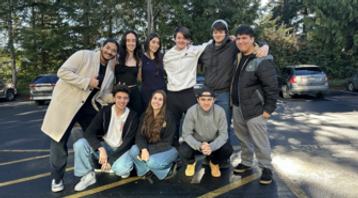
Team: Nap Interrupted
-
Aviral Gusain: Programmer
-
Izaro Gondra: Artist
-
Jared Callupe Lopez: Technical UI Designer & Level Designer
-
Lawrence Winters: Gameplay Programmer
-
Lucas Serrano: Artist
-
Lucia Sierra Moilanen: Artist
-
Lucia Zumarraga Ocio: Artist
-
Riley Durbin: Gameplay & Serialization Programmer
-
Taylor Cadwallader: Designer View Portfolio
Our nine-person team came together at the Seattle Indies jam site hosted at DigiPen Institute of Technology: three programmers, two designers, and four artists, with all four artists visiting as exchange students from Spain. Under the 48-hour limit, Taylor and I ended up implementing much of what we designed ourselves, while the programmers built the bubble routing and level serialization systems. I owned the entire front-end UI and all of the game's levels, and our artists produced the illustrations, sprite sheets, and animations that gave Bloops its personality.

Designing the UI: A Bathtub Come Alive
Our artists put together a wonderful bathtub illustration for the main menu, but looking at it on screen, I felt the scene was too static for a game about bubbles floating around. I asked them for animated bubble sprite sheets to work with and built the menu around them, adding a parallax bathtub layer that shifts as the player moves through the menu along with a particle system that sends their animated bubbles continuously rising up the screen.
I also made the emitter disable itself whenever a submenu opens, so floating bubbles never drift over navigation elements, and re-enable when the player returns to the main menu. It's a small touch, but it required explicit state awareness between the menu system and the particle system. I was sitting right next to the artists while implementing their assets, so we could go back and forth on what was working and adjust things on the spot.

Main menu parallax and particle bubbles in action

Bubble particle and parallax objects set up in the Unity editor
Front-End Architecture: Every Screen Within 48 Hours
Beyond the main menu, I implemented the complete front-end experience: level select, pause menu, options, credits, HUD, and confirmations of destructive action, the same UX standard I established on previous projects like KnightLight. All navigation flow and state management were scripted in C#. Building a full, coherent menu system inside a single weekend was only possible because of the patterns I had already developed on longer projects.


Front-end screens built during the jam


Confirmations of destructive action in-game
Teaching the Game: Tutorialization in a Jam
With the deadline closing in, we still had no way to teach new players what Bloops actually was. I built a short slideshow tutorial that runs before the first level, where our mascot walks the player through the goal and the basics in three screens of dialogue paired with screenshots of the game. A next button advances each slide, and the last one drops the player straight into Level 1.
It's the simplest system on the list, and that was the point. With a few hours left, a scripted slideshow was something I could build, write, and hook up reliably, and it meant nobody sat down to a grid of bubbles and soap with no idea what to do.


The three tutorial slides shown before the first level
Level Design: Ten Levels, One Scoring Rule
I designed all 10 levels, introducing mechanics progressively and scaling the grid size up as players advanced, which meant coordinating with our serialization engineer on what the engine could support at each size. Each level is cleared by guiding at least three bubbles into the drain. For scoring, I gave each level a par: an expected budget for each toolbox item, set by finding the level's minimum solution. The game compares how the player finished against that budget and awards up to three stars, so efficient solutions are rewarded without ever punishing a player for simply finishing.

Paper draft of all 10 levels, notice the expected item count for each level's par


Placing toolbox items to route bubbles from dispenser to drain

A later level in action
Post-Mortem: Designing at Jam Speed
Bloops compressed an entire production cycle into one weekend, and it sharpened lessons that longer projects had hinted at:
-
Communication as a Design Tool: Our art team was predominantly Spanish-speaking and our programmers were English-only, with the designers sitting in the middle. Serving as the bridge between these two disciplines, I was making sure what engineering needed from art and vice versa actually got communicated and understood under the deadline pressure.

Comments made by artist Lucas Serrano regarding implementation
-
Reusable Patterns: The only reason the complete menu system was possible in 48 hours was that I had already solved menu architecture in previous projects. Bringing established UX standards, like confirmations of destructive action, meant I was implementing existing patterns instead of inventing them under pressure.

Menu system in action
-
State Handling: The bubble emitter that turns itself off when submenus open is the kind of detail nobody consciously notices, but it's the difference between a menu that feels finished and one that feels like a rushed game.
Play The Game!
Bloops is free to download from its Global Game Jam page, where you can also watch the trailer and see everything our team pulled off in one very short weekend. If you give it a try, I'd love to hear how many levels you can clear at three stars, and as always, feel free to reach out if you want to talk about the game or jam development in general!
